Assi / Joseph MEIDAN
1987/Ongoing
Working between object, space, and material research. His practice focuses on transformation — observing how materials shaped by construction, use, and time can be redirected through minimal intervention.
His work often begins with situations encountered in everyday environments: construction sites, industrial components, or standardized building systems. Through processes of collection, assembly, and displacement, these elements are recontextualized without erasing their origin.
Moving between unique pieces and evolving systems, his projects explore the moment where functional structures shift into objects of domestic or spatial presence. Light, support, and construction recur as central themes, approached as ongoing investigations rather than fixed forms.
Alongside independent works, he develops Brut Hardware, a modular aluminum framework conceived as an open structure capable of adapting across furniture, exhibition, and architectural contexts.

Photo by Max Mindell
︎︎︎ Linkdin

01 SIDEWALK VEILS
A series of fragments of temporary pedestrian sidewalks have been collected from construction sites encountered across the city. Installed to maintain circulation during periods of transformation, these platforms form a discreet and provisional layer of urban architecture — functional structures designed to disappear once construction ends.
Recovered during dismantling phases, the elements bear traces of use, exposure, and demolition. Originally conceived as short-term infrastructure, they are reassembled with stone components to produce a series of unique lamps.
The work shifts material from an ephemeral urban condition into a permanent domestic presence. Light operates as a continuation rather than a transformation, extending the lifespan of elements already shaped by time and circumstance.
Each piece preserves the tension between temporary function and lasting object, where dismantling becomes a moment of transition rather than conclusion.
A series of fragments of temporary pedestrian sidewalks have been collected from construction sites encountered across the city. Installed to maintain circulation during periods of transformation, these platforms form a discreet and provisional layer of urban architecture — functional structures designed to disappear once construction ends.
Recovered during dismantling phases, the elements bear traces of use, exposure, and demolition. Originally conceived as short-term infrastructure, they are reassembled with stone components to produce a series of unique lamps.
The work shifts material from an ephemeral urban condition into a permanent domestic presence. Light operates as a continuation rather than a transformation, extending the lifespan of elements already shaped by time and circumstance.
Each piece preserves the tension between temporary function and lasting object, where dismantling becomes a moment of transition rather than conclusion.
2015/Ongoing

02 SEE YOU TABLE
This table is constructed from a CNC-milled wooden surface combined with precisely cut stone inserts. The wood is shaped through subtraction, forming recessed areas that receive different stones, each introducing its own texture, density, and thermal behavior.
Cut by water-jet, the stone elements act as stable islands across the surface — areas designed to receive warm objects directly, integrating use into the material logic of the piece rather than protecting it through applied layers.
The composition emerges from the assembly of abstract forms that together suggest a face, a recurring figure within the work. The image remains unstable: perceptible from a distance, dissolving into material relationships at close range.
Operating between furniture and topography, the table negotiates softness and permanence, carving and cutting, warmth and resistance, while introducing a subtle ludic narrative — an object that shifts between function, image, and interpretation.
This table is constructed from a CNC-milled wooden surface combined with precisely cut stone inserts. The wood is shaped through subtraction, forming recessed areas that receive different stones, each introducing its own texture, density, and thermal behavior.
Cut by water-jet, the stone elements act as stable islands across the surface — areas designed to receive warm objects directly, integrating use into the material logic of the piece rather than protecting it through applied layers.
The composition emerges from the assembly of abstract forms that together suggest a face, a recurring figure within the work. The image remains unstable: perceptible from a distance, dissolving into material relationships at close range.
Operating between furniture and topography, the table negotiates softness and permanence, carving and cutting, warmth and resistance, while introducing a subtle ludic narrative — an object that shifts between function, image, and interpretation.
2018/Ongoing
03 OH NO, DON’T WORRY
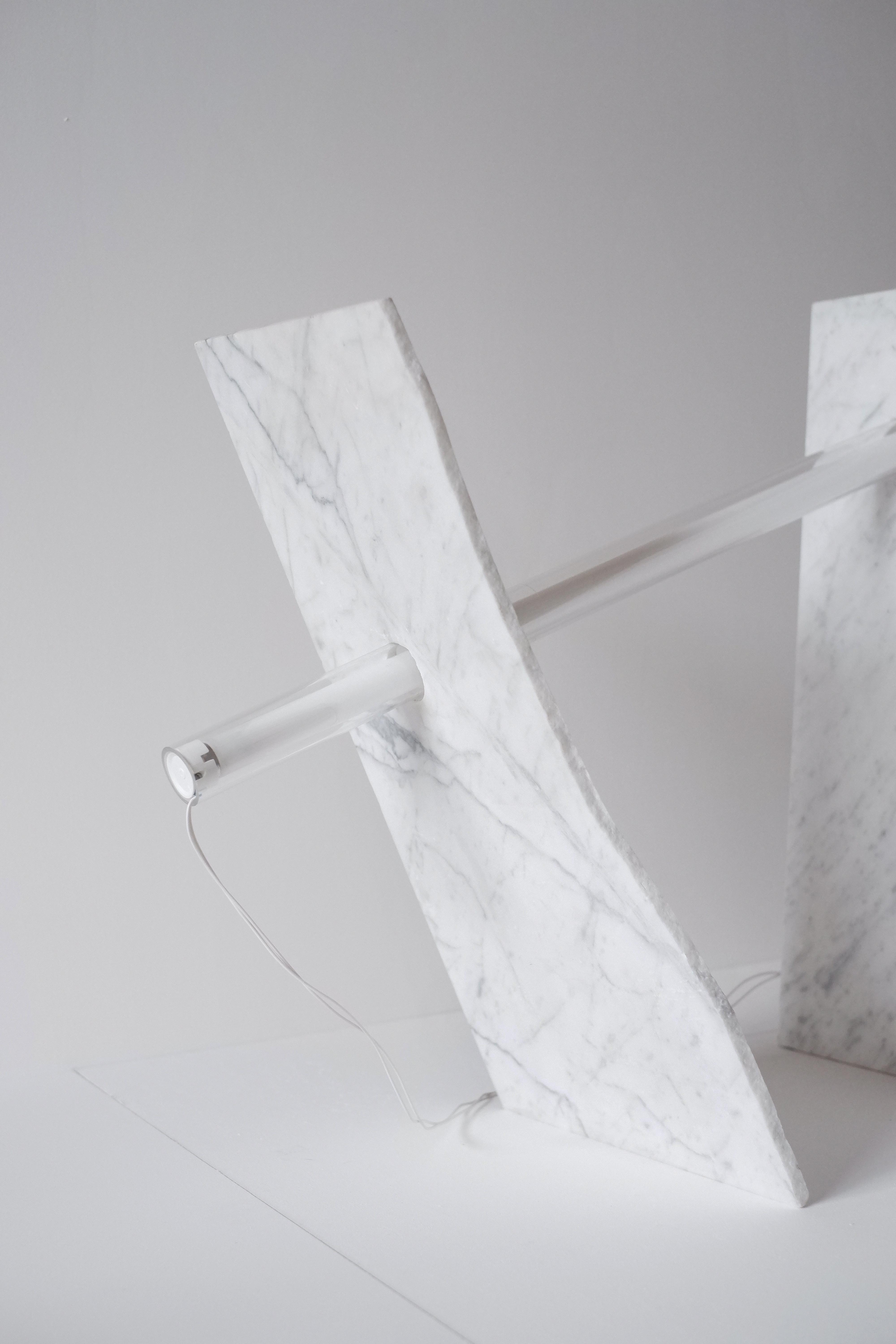
Oh No, Don’t Worry is a series of lamps in which light acts as both illumination and structure. The luminous element connects separate components, holding together heavy stone pieces that are pierced and suspended along its axis.
Each stone is fixed through a precise opening, functioning as a geometric stop that interrupts movement and stabilizes the composition. Rather than concealing construction, the lamp reveals how balance is achieved — weight, gravity, and alignment becoming visible parts of the object.
The work emphasizes connection as a physical condition. Materials of different densities meet through a minimal intervention, allowing the light itself to organize the structure. Stones are not decorative elements but active participants, defining position, tension, and equilibrium.
The lamp becomes a system of relationships where mass and light negotiate stability, giving equal importance to structure, material presence, and the act of holding things together.
Oh No, Don’t Worry is a series of lamps in which light acts as both illumination and structure. The luminous element connects separate components, holding together heavy stone pieces that are pierced and suspended along its axis.
Each stone is fixed through a precise opening, functioning as a geometric stop that interrupts movement and stabilizes the composition. Rather than concealing construction, the lamp reveals how balance is achieved — weight, gravity, and alignment becoming visible parts of the object.
The work emphasizes connection as a physical condition. Materials of different densities meet through a minimal intervention, allowing the light itself to organize the structure. Stones are not decorative elements but active participants, defining position, tension, and equilibrium.
The lamp becomes a system of relationships where mass and light negotiate stability, giving equal importance to structure, material presence, and the act of holding things together.
2012/Ongoing

04 BRUT HARDWARE
Brut Hardware is an ongoing project developed as an open structural system made from folded aluminum elements. Conceived as both object and tool, it explores how a minimal construction logic can generate multiple spatial and functional outcomes.
The system is based on a limited vocabulary of parts — supports, connectors, and planes — designed to be repeatedly assembled, extended, or reconfigured. Rather than producing fixed furniture, Brut Hardware proposes a framework where structure remains visible and adaptable, allowing use to continuously redefine form.
Emerging from an interest in industrial fabrication and material economy, the project treats construction as a language in itself. Holes, folds, and standardized dimensions become active design elements, shifting attention from finished appearance to processes of assembly and transformation.
https://www.bruthardware.com/
Brut Hardware is an ongoing project developed as an open structural system made from folded aluminum elements. Conceived as both object and tool, it explores how a minimal construction logic can generate multiple spatial and functional outcomes.
The system is based on a limited vocabulary of parts — supports, connectors, and planes — designed to be repeatedly assembled, extended, or reconfigured. Rather than producing fixed furniture, Brut Hardware proposes a framework where structure remains visible and adaptable, allowing use to continuously redefine form.
Emerging from an interest in industrial fabrication and material economy, the project treats construction as a language in itself. Holes, folds, and standardized dimensions become active design elements, shifting attention from finished appearance to processes of assembly and transformation.
https://www.bruthardware.com/
2025/Ongoing

05 SHAKES
Shakes is an ongoing sculptural series produced over several years using large plastic drinking cups sourced locally at each place of production. Every iteration reflects its immediate environment: materials, colors, and compositions change according to what is available at a specific moment and location.
Rather than following a fixed formal intention, the works register shifts in context over time. Each piece becomes a localized record, embedding traces of place, period, and circumstance within a familiar and accessible form.
The series operates as a dispersed archive, where repetition allows variation to emerge. What appears playful at first reveals itself as a temporal marker, capturing changing environments through material assembly and preserving moments of production within a continuous body of work.
Shakes is an ongoing sculptural series produced over several years using large plastic drinking cups sourced locally at each place of production. Every iteration reflects its immediate environment: materials, colors, and compositions change according to what is available at a specific moment and location.
Rather than following a fixed formal intention, the works register shifts in context over time. Each piece becomes a localized record, embedding traces of place, period, and circumstance within a familiar and accessible form.
The series operates as a dispersed archive, where repetition allows variation to emerge. What appears playful at first reveals itself as a temporal marker, capturing changing environments through material assembly and preserving moments of production within a continuous body of work.
2012 / Ongoing
06
GARDEN - COMME DES GARÇONS
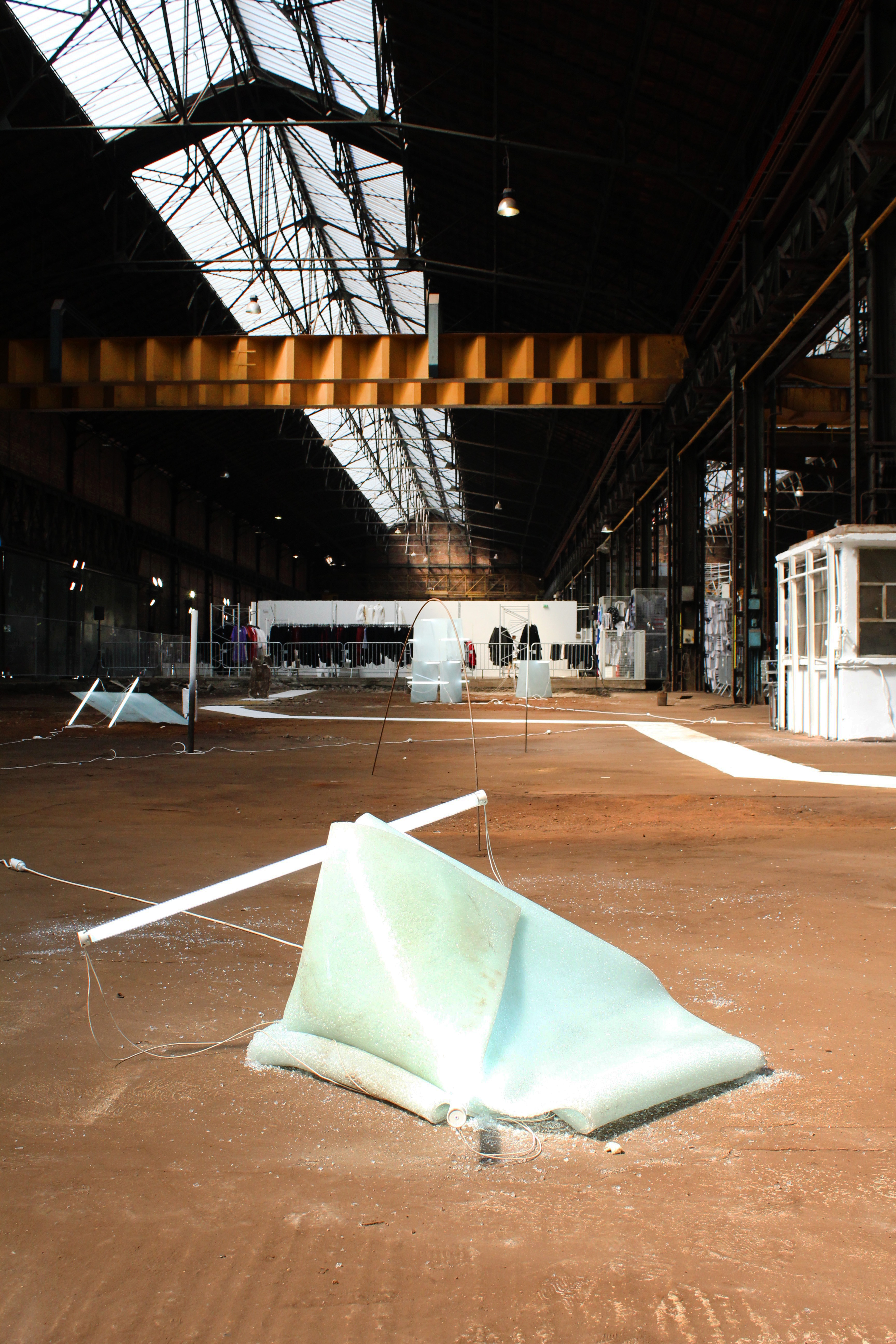
A large-scale installation conceived as an environment inviting continuous movement through space, equally activated during day and night. The project occupies approximately 1,000 m² and unfolds as a walkable landscape structured through reclaimed architectural elements and light.
The installation is built from glass façade panels recovered from a dismantled building and reassembled into a new spatial sequence. Lines of neon light, enclosed within protective plexiglass, connect the fragments and act simultaneously as structure, illumination, and orientation, guiding circulation across the space.
Some panels reveal an unexpected material ambiguity: composed of two layers of glass laminated with a silicone sheet, they behave almost like fabric, introducing flexibility and softness within an otherwise rigid system. Transparency, reflection, and diffusion continuously shift according to changing light conditions.
A large-scale installation conceived as an environment inviting continuous movement through space, equally activated during day and night. The project occupies approximately 1,000 m² and unfolds as a walkable landscape structured through reclaimed architectural elements and light.
The installation is built from glass façade panels recovered from a dismantled building and reassembled into a new spatial sequence. Lines of neon light, enclosed within protective plexiglass, connect the fragments and act simultaneously as structure, illumination, and orientation, guiding circulation across the space.
Some panels reveal an unexpected material ambiguity: composed of two layers of glass laminated with a silicone sheet, they behave almost like fabric, introducing flexibility and softness within an otherwise rigid system. Transparency, reflection, and diffusion continuously shift according to changing light conditions.
2016

07
ARCHITECTURAL DESIGN / BUREAU411
Under Bureau411, architecture is approached as an extension of material and spatial research developed through objects and systems. Projects focus on transformation rather than replacement, working with existing conditions, constraints, and structures as primary design material.
Interventions often begin with what is already present — spaces in transition, reused elements, or unfinished situations — allowing architecture to emerge through adjustment, assembly, and selective intervention. The work seeks clarity through reduction, where construction, use, and atmosphere are closely aligned.
Across interiors, exhibitions, and built environments, Bureau411 develops spaces where function and perception evolve together, emphasizing durability, precision, and a direct relationship between material presence and experience.
*The architectural practice of Bureau411 has been shaped through an important collaboration with Architect and designer Dror Tshuva, whose partnership has played a central role in the development of these projects.
Under Bureau411, architecture is approached as an extension of material and spatial research developed through objects and systems. Projects focus on transformation rather than replacement, working with existing conditions, constraints, and structures as primary design material.
Interventions often begin with what is already present — spaces in transition, reused elements, or unfinished situations — allowing architecture to emerge through adjustment, assembly, and selective intervention. The work seeks clarity through reduction, where construction, use, and atmosphere are closely aligned.
Across interiors, exhibitions, and built environments, Bureau411 develops spaces where function and perception evolve together, emphasizing durability, precision, and a direct relationship between material presence and experience.
*The architectural practice of Bureau411 has been shaped through an important collaboration with Architect and designer Dror Tshuva, whose partnership has played a central role in the development of these projects.
2020/Ongoing

08 BULK
This section gathers works that exist outside defined series or long-term projects. Produced across different moments, contexts, and scales, they operate as experiments, studies, or isolated gestures.
Some explore materials or construction ideas that later reappear elsewhere; others remain singular outcomes tied to specific situations. Presented together, they reveal parallel directions and underlying questions that run through the practice.
Rather than secondary works, these pieces form an open field of investigation — a space where intuition, testing, and observation remain visible.
This section gathers works that exist outside defined series or long-term projects. Produced across different moments, contexts, and scales, they operate as experiments, studies, or isolated gestures.
Some explore materials or construction ideas that later reappear elsewhere; others remain singular outcomes tied to specific situations. Presented together, they reveal parallel directions and underlying questions that run through the practice.
Rather than secondary works, these pieces form an open field of investigation — a space where intuition, testing, and observation remain visible.
2010/Ongoing